
Computational Thinking
Within Jeannette Wings (2006) article, she explores the multifaceted concept of computational thinking and unravels all that it is (and isn’t). She describes computational thinking as a skill for every person to know which encompasses the tools that are needed in computer science (Wing, J., 2006). Computational thinking encourages problem solving thinking for all as people need to learn the skills to deal with many different issues. As computer science is part of every career, students need to learn these skills in order to function in the world. In order to teach students to be competent computer users, we must teach computational thinking hand in hand (Florez, B., 2017). As teachers, we need to begin teaching these skills as early as primary school, in order to develop the cognitive skills needed to be computational thinkers (Florez, B., 2017) but as a lot of teachers aren’t professional coders, how do we give our students the best chance to learn these skills?
Computational Thinking and Blockly Games
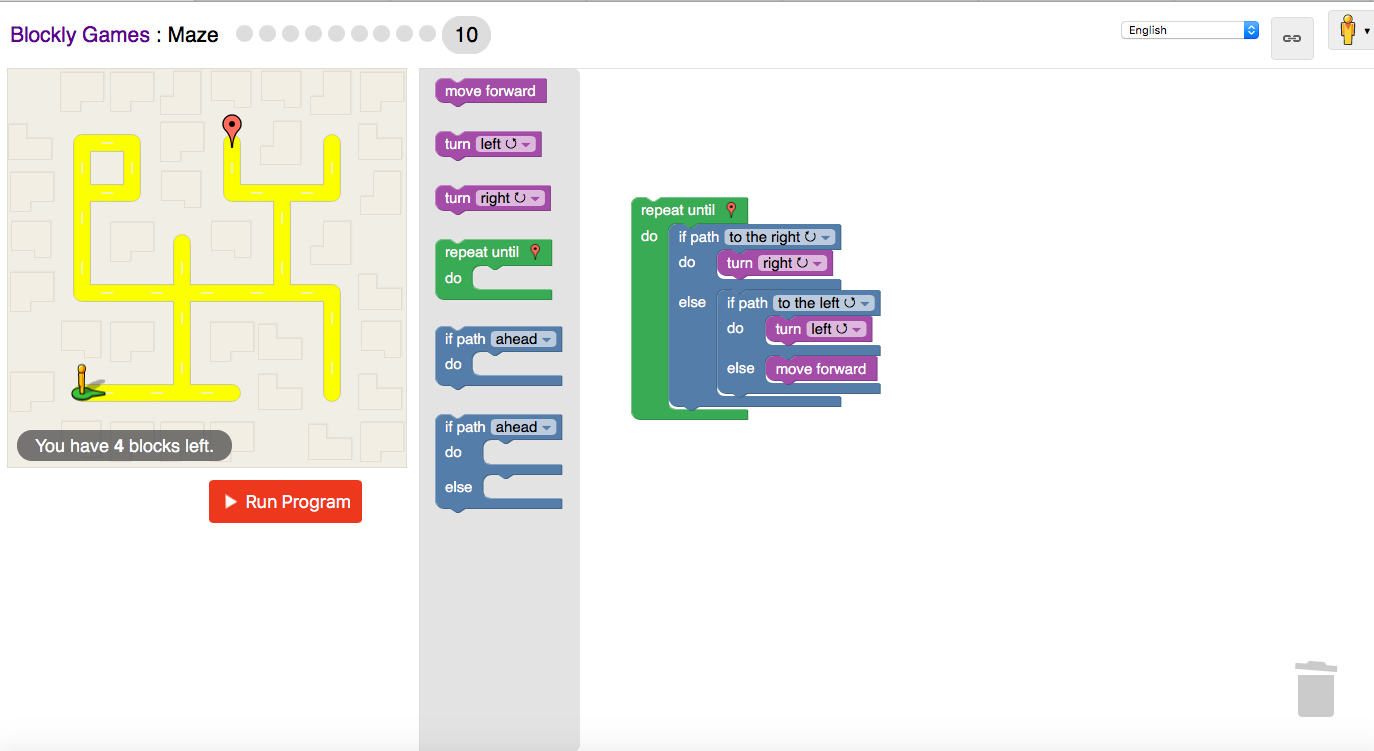
There are many applications out there for teacher to use as a way to teach computational thinking, and one of these tools is Blockly Games. Blockly is a free to use website that uses blocks to represent code. Blocky games uses the same concept to teach basic programming concepts (Galan, D., 2017). One tool that I was able to play around with was Blockly Maze. While looking around at other codding programs, I found them all to be very open ended, where blockly maze stood out was the ability to learn coding while having a clear objective in sight. Students have to use the coding blocks provided to move their person through a maze. They are limited to how many blocks they can use. This program starts off basic and builds in difficulty as they progress.
Classroom Implementation
Blockly maze encourages computational thinking as students have to problem solve and further develop those thinking skills. As students progress in difficulty, they find that they may end up stuck in a loop or not quite complete the maze. Students have to use this abstract thinking to try many different ways of coding to find the one that allows them to finish the maze within the limit set. By introducing this program into a classroom, teachers have an easy and efficient way to begin fostering computational thinking.
Referencing
Wing, J. (2006). Computational thinking. Communications of the ACM, 49(3), 33-35.
Buitrago Flórez, F., Casallas, R., Hernández, M., Reyes, A., Restrepo, S., & Danies, G. (2017). Changing a Generation’s Way of Thinking: Teaching Computational Thinking Through Programming. Review of Educational Research, 87(4), 834-860
Galan, D., Dormido, & Esquembre. (2017). Conducting Online Lab Experiments with Blockly. IFAC PapersOnLine, 50(1), 13474-13479.
 Asha Beaton
Hi Asha. Cool post on Blocky Games. It seems like a fun way of introducing students into the world of computational thinking, and basic programming and coding. The open environment allows them to freely move around the coded blocks provided to complete the aim of the game. Although creativity was limited in your post, I can still see how the objective and limitations of what the user can do will guide students to use their creativity, in order to program a route that will get them to the end of the maze. Overall, it was a clear and insightful post on computational thinking within the classroom. Nice share! – Lachlan
LikeLike